
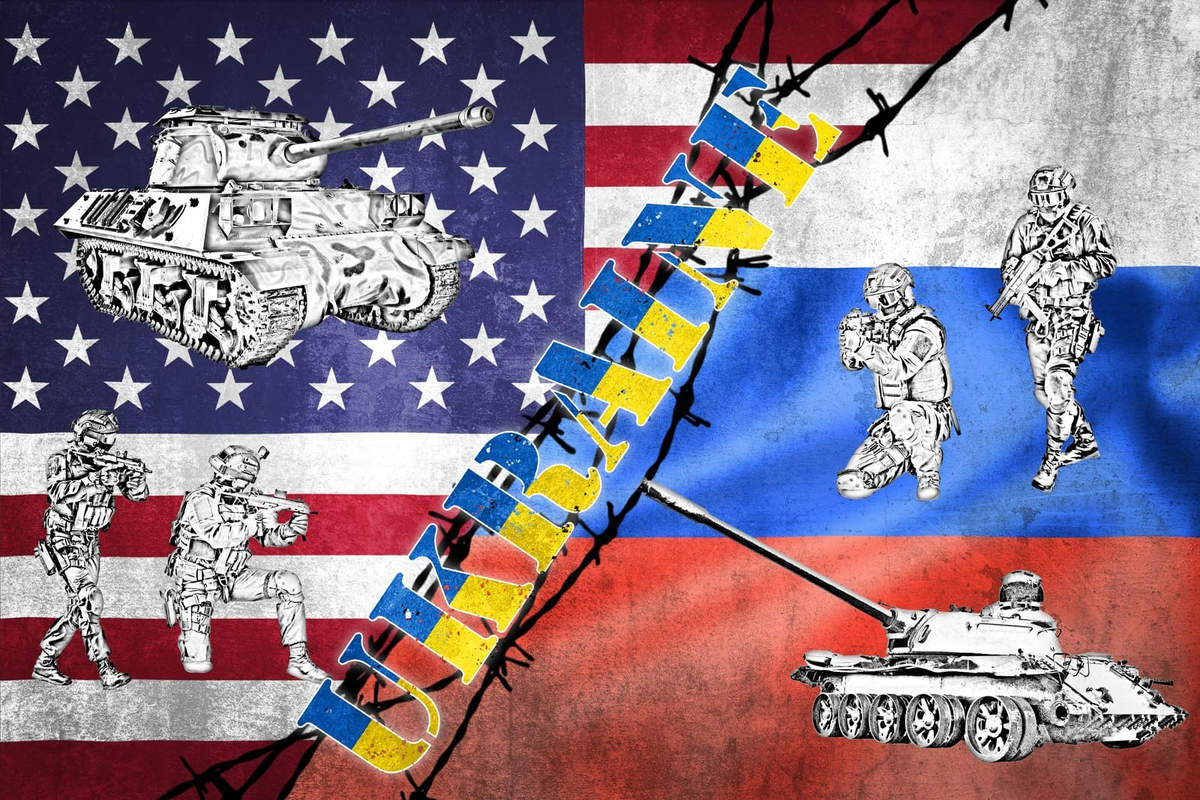
Between geopolitical calculations, Russian economic resilience, and diverging interests, the conflict is bogging down in a war of attrition that neither side seems willing to end.
By Robert Harneis
The war in Ukraine is entering its fifth year with no negotiated way out in sight for either belligerent. Behind the mud of the trenches and the victory communiqués, a complex machinery — military, economic, diplomatic — has taken hold, keeping the conflict in a precarious equilibrium. An in-depth look.
A long war no one wanted, pursued by everyone
Neither Moscow nor Kyiv anticipated such a prolonged conflict. In 2022, Russia hoped for a lightning victory through decisive strikes on Kyiv, Kharkiv, and the corridor leading to Crimea. The West, for its part, was betting on a rapid collapse of the Russian economy under the weight of unprecedented sanctions — the freezing of $300 billion in reserves, exclusion from the SWIFT system, diplomatic isolation. Both sides were disappointed.
Today, the conflict follows a logic of attrition. Russia is waging a slow war, aware that it faces a Ukraine backed by the financial and military arsenal of the United States, NATO, and most Western countries. The model is simple: Ukraine provides the men, the West provides the weapons.
Russia: a more resilient economy than expected
One of the great surprises of this conflict has been the resilience of the Russian economy. The West had severely underestimated its degree of self-sufficiency. As a producer of its own energy and food resources, with an industrial base inherited from the Soviet era and relatively insulated from financialization, Russia has managed to adapt.
According to the IMF, measured in purchasing power parity, the country is now ranked the world’s fourth-largest economy, behind China, the United States, and India. Paradoxically, the sanctions stimulated local production through import substitution and encouraged the repatriation of capital. Russia’s military-industrial complex has demonstrated its capacity to sustain a prolonged war effort, notably through the reactivation of Soviet-era stockpiles and the use of low-cost guided munitions.
Ukraine: between survival and dependency
On the Ukrainian side, internal factors are complicating any prospect of negotiation. The Kyiv government benefits from massive financial flows tied to the war effort. The radical nationalist units that form part of the military apparatus have publicly threatened to turn on Zelensky should he sign a peace deal with Moscow — thereby betraying the 2019 electoral promise that brought him to power.
A conflict with global geopolitical dimensions
For Moscow, as Foreign Minister Sergei Lavrov has stated, the Ukrainian war is not an isolated territorial conflict but a symptom of a broader struggle: the one waged by Washington to preserve its hegemony in the face of China’s rise and Russia’s renewed military power. In this context, Beijing is quietly backing Moscow — Sino-Russian trade has grown significantly — while Russia simultaneously maintains good relations with New Delhi to avoid exclusive dependence on a single partner.
The accession of Finland and Sweden to NATO represents a strategic setback for Moscow, however, adding some 1,340 kilometers of shared border with the Atlantic Alliance. In response, the development of BRICS offers Russia channels to circumvent sanctions, reducing its dependence on the dollar in international trade.
War objectives in flux
On the Russian side, ambitions have gradually shifted. From a simple stabilization of the status quo in 2022, Moscow moved to formally annexing four Ukrainian regions, while some internal voices are now calling for even broader territorial conquests. Should the conflict continue without a negotiated solution, the equation could close in on far graver scenarios.
BY THE NUMBERS
- 1.5 million lives lost according to various estimates since the conflict began in 2022
- 4th largest economy in the world — Russia’s ranking according to the IMF in purchasing power parity.
- 1,340 km of additional borders with NATO since the accession of Finland and Sweden. Sonnet 4.6