
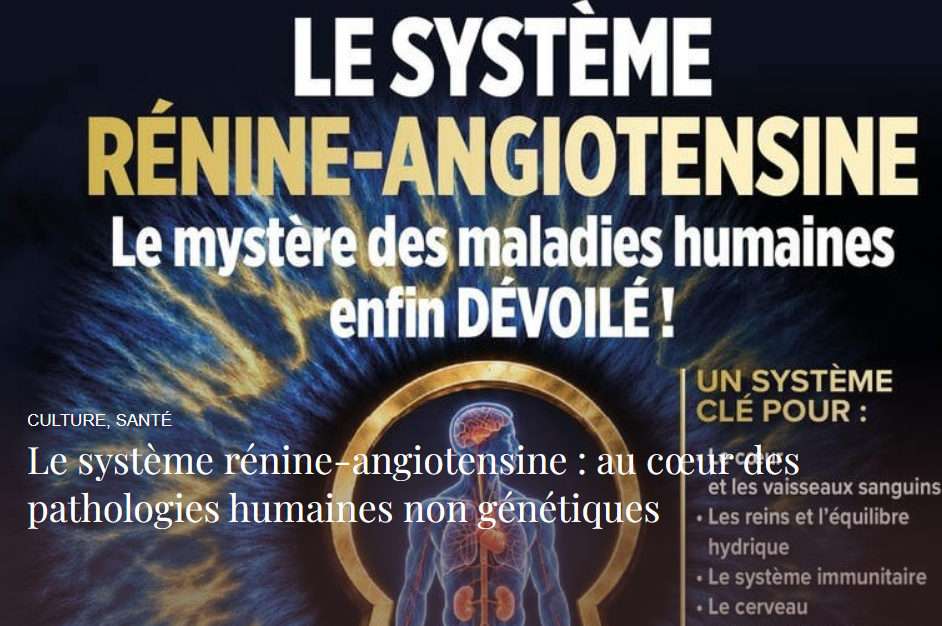
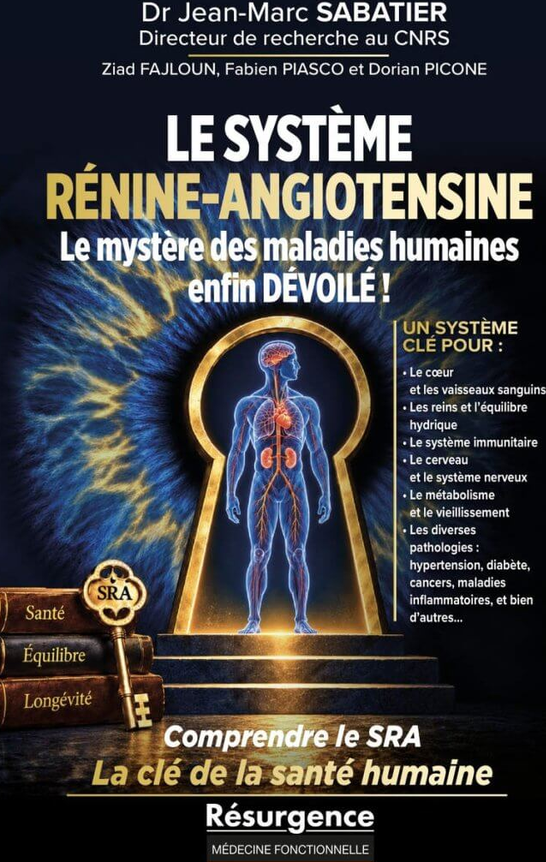
In a book published by Éditions Marco Pietteur, Dr. Jean-Marc Sabatier, Director of Research at the CNRS (French National Centre for Scientific Research), along with Ziad Fajloun, Fabien Piasco, and Dorian Picone, proposes a thorough reassessment of our understanding of the renin-angiotensin system (RAS).
What if the many human diseases we currently consider distinct actually share common biological mechanisms?
This is one of the central questions of this book dedicated to the renin-angiotensin system (RAS).
The RAS is generally presented as a hormonal system responsible for controlling blood pressure, fluid and sodium balance, and kidney function. Today, this view has become overly restrictive. The RAS constitutes a biological network present in all organs and tissues, capable of interacting with the cardiovascular, nervous, immune, endocrine, and metabolic systems.
Its role therefore goes far beyond that of a simple blood pressure regulator.
A True Regulatory System of the Body
The functioning of the RAS relies on a complex balance among several peptides, enzymes, and receptors. Angiotensin II and its AT1 receptor play a major role, but they make up only part of this system. Other pathways—particularly those involving ACE2, angiotensin-(1-7), and the AT2 receptor—often exert complementary or antagonistic effects.
This organization enables the RAS to help regulate vascular tone, inflammation, oxidative stress, cell growth, fibrosis, energy metabolism, and immune responses.
A fundamental question therefore arises: what happens when this balance is persistently disrupted?
From Dysregulation to Disease
Excessive or inappropriate activation of certain RAS pathways can promote a range of mechanisms that may contribute to various pathologies: endothelial dysfunction, chronic inflammation, oxidative stress, vascular remodeling, fibrosis, disrupted energy metabolism, and altered immune responses.
These mechanisms are found across a wide array of seemingly very different conditions.
It is precisely this cross-cutting nature that makes the RAS such a compelling system.
Hypertension, cardiovascular diseases, kidney disorders, metabolic conditions, certain neurological pathologies, inflammatory or fibrotic processes, and pathological aging—very different conditions may share underlying biological mechanisms.
The RAS could thus serve as the major pathophysiological crossroads linking these various diseases.
Another Way of Looking at Disease
Modern medicine has progressively developed extreme specialization: cardiology, neurology, nephrology, endocrinology, immunology, pulmonology, gastroenterology, and so on.
While this specialization is essential, it can sometimes lead to studying biological phenomena in isolation when they are actually in constant communication.
The RAS, by contrast, invites us to adopt a more integrated perspective.
Vascular dysregulation can affect the kidneys. The kidneys can alter RAS activity. The RAS can act on the nervous and immune systems. Inflammation, in turn, can disrupt metabolic balance. Cellular metabolism can influence inflammatory and vascular responses.
The body operates as a network, and the RAS is a system that enables this network to communicate and adapt.
Why Focus on Non-Genetic Pathologies?
Human diseases rarely stem from a single cause. Genetic factors may create susceptibility, but the environment, diet, aging, infections, medications, toxins, physiological stress, metabolic disturbances, and cardiovascular factors can profoundly alter how the body functions.
From this perspective, the RAS could represent a point of convergence between predisposition and environment.
In other words, different triggers could lead, under certain conditions, to shared biological dysregulations involving the RAS.
This points to a broader hypothesis: acquired diseases could be viewed not merely as a collection of independent illnesses, but as the manifestation of an imbalance in a major, ubiquitous regulatory system.
The RAS would then be that fundamental system.
The RAS: A “Master System”?
This is the hypothesis explored in this book.
The term “master system” implies that the RAS lies at the root of disease. It could hold a strategic position in organizing numerous physiological and pathological processes.
This distinction is essential.
The RAS helps explain why vastly different diseases exhibit shared mechanisms.
Understanding this architecture also sheds light on why certain therapeutic interventions targeting the RAS have effects that go well beyond simply lowering blood pressure.
Toward a New Vision of Pathophysiology
The goal of this book is therefore to offer a new framework for interpretation.
Rather than viewing each disease as an isolated phenomenon, the aim is to identify the overarching biological system that connects the body’s organs.
The RAS is particularly noteworthy in this regard because it sits at the intersection of blood circulation, the kidneys, the nervous system, the immune system, and metabolism.
It could thus serve as one of the key threads helping us better understand the transition from physiological balance to disease.
What if, behind a multitude of seemingly different conditions, lay in part a single underlying issue: the loss of balance in fundamental regulatory systems?
That is the question this book asks.
Understanding the RAS may mean understanding one of the core biological languages connecting our organs, physiology, and disease.
The mystery of human diseases finally unveiled.
Le Système rénine-angiotensine – Le mystère des maladies humaines enfin dévoilé ! (The Renin-Angiotensin System: The Mystery of Human Diseases Finally Unveiled!), Éditions Marco Pietteur, Résurgence collection. Price: €30.