

Eighty-nine days of total digital blackout. Six hours of reconnection. A naval facility destroyed near Jask. The metadata trap has just snapped shut on the Islamic Revolutionary Guard Corps.
For 88 days, Iran’s southern provinces were cut off from the digital world. Tehran openly framed the move as a shield against foreign psychological warfare operations and against potential new connected military technologies that could give the United States a decisive advantage. It was a survival strategy for the fully networked age.
On the 89th day, the fiber-optic cables linking Bandar Abbas to Chabahar were switched back on. Six hours later, a strike bearing the unmistakable signature of U.S. Central Command (CENTCOM) destroyed a naval facility suspected of housing IRGC fast-attack boats roughly 15 miles east of Jask.
“If you connect to the internet, you die.” Brutal as it sounds, the phrase now sums up the operational doctrine taking shape in this part of the world.
88 Days in Digital Darkness
To understand what happened, one first has to grasp what those three months of electronic silence meant for American intelligence capabilities. The NSA’s SIGINT collection systems — capable of absorbing terabytes of communications and geolocation signals — were effectively running blind.
The IRGC Navy, meanwhile, had reverted to Cold War-era methods: couriers, field telephones, and short encrypted burst transmissions.
For an AI-driven command-and-control system like the American JADC2 architecture, this total disconnection created an intolerable fog of war. It became impossible to target the source of a swarm of kamikaze drones when the source itself was invisible.
The Crack: A Fatal Economic Decision
The reconnection was not the result of a coordinated strategy. It stemmed from a unilateral concession by President Pezeshkian under pressure from two fronts: petrochemical magnates in southern Iran and a hyperconnected population suffering digital withdrawal.
Eighty-eight days without SWIFT transactions or market access had drained the economies of the southern provinces.
According to reports, the decision was made against the explicit advice of IRGC intelligence services, which wanted the blackout maintained indefinitely in the name of operational security for naval exercises in the Gulf of Oman.
2:14 a.m. local time. The first data packets begin moving across the Iranian network. American passive collection systems activate immediately.
Resynchronization phase. Personal phones belonging to IRGC logistics officials — believing their devices undetectable thanks to new IMEI numbers — begin checking WhatsApp, Facebook, Instagram, and TikTok.
Less than six hours later, targeting algorithms detect a constellation of geolocated signals converging on a previously inactive site near Jask. The strike is authorized.
The Metadata Trap
Washington did not need to decrypt a single encrypted message. It only had to map the sudden aggregation of signals: the phone of a logistics coordinator heading to a depot, the tablet of a commander checking weather forecasts in the Gulf of Oman, the computer of a port official accessing a cargo manifest server. For JADC2, the veil had lifted. The target had become visible.
“The United States didn’t need to crack encrypted content. It simply mapped the sudden constellation of geolocated signals clustered around a known but previously inactive site. That’s the metadata trap. It’s always deadly,” according to a local source.
A Fracture at the Top of the Iranian State
The strike — reportedly carried out using a combination of carrier-based F-35Cs and a sea-launched Tomahawk missile variant — triggered an internal political crisis.
IRGC generals reportedly turned directly against the presidency, accusing it of having “opened a breach.” Pezeshkian’s advisers deny any direct causal link.
Iran announced retaliatory measures and condemned the attack as a violation of the ongoing ceasefire. An MQ-9 Reaper drone was reportedly shot down during the operation, and an F-35C is said to have come under fire.
This episode goes beyond the Iranian case alone. It sheds light on Russia’s sporadic internet shutdowns and on the ongoing overhaul of China’s Great Firewall.
In 2026, access to the electromagnetic spectrum has become both the first casualty — and the primary vector — of modern warfare. Restoring connectivity can itself become the trigger.
The United States has now established a precedent: reconnecting a hostile state to the internet is treated as a moment of exposure, one potentially warranting an immediate kinetic response.
Further reading: Strategika
The Internet: America’s Invisible Weapon of Strategic Dominance
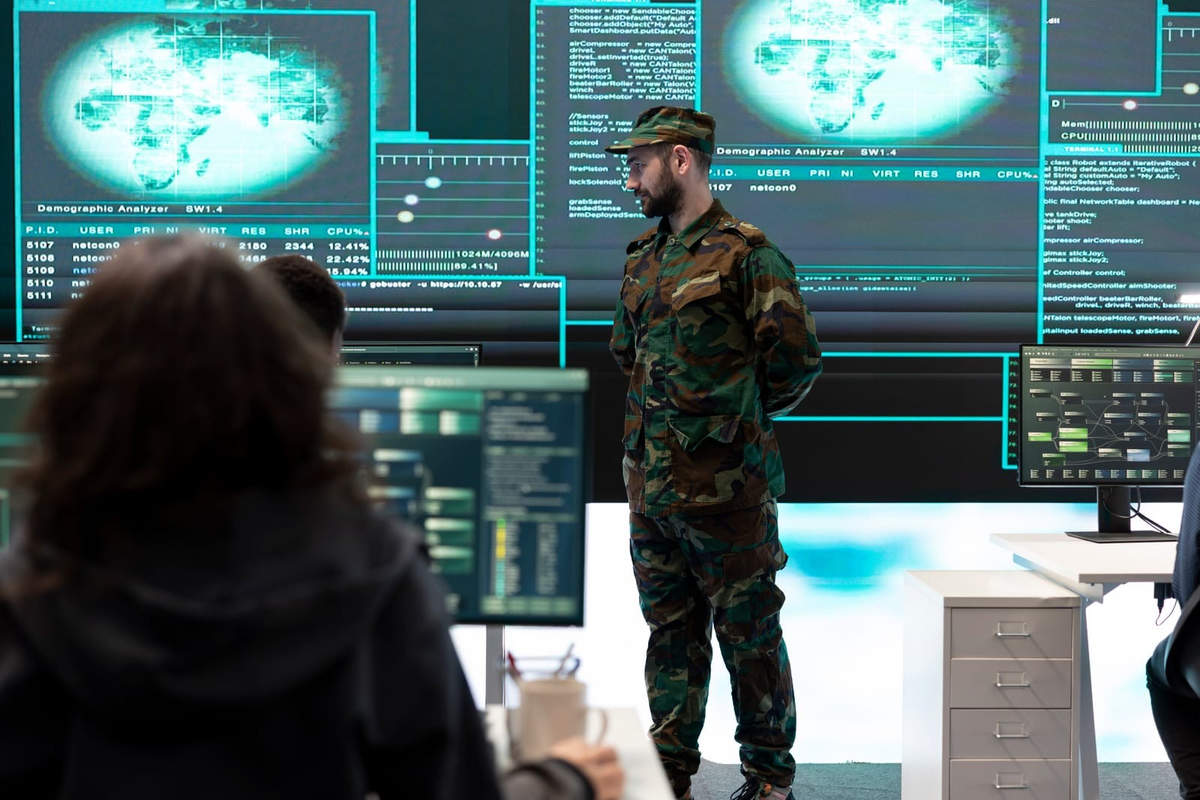
Artificial intelligence, cyberspace, and satellite networks are redefining the art of war. In this new global battlefield, the United States maintains a strategic edge thanks to its control over the world’s digital infrastructure.
In the age of hybrid warfare and the digital battlefield, military superiority is no longer measured solely by armored divisions or nuclear arsenals. It now depends on the ability to effectively integrate artificial intelligence, space-based networks, and cyber operations into a global command architecture. In this decisive domain, the United States retains a major strategic advantage: its de facto sovereignty over the global Internet.
A Structuring Technological Dominance
The core architecture of the Internet — from undersea cables to root servers, including major digital platforms and technological standards — remains largely controlled by American actors or subject to U.S. jurisdiction. This reality gives Washington an unparalleled strategic lever, enabling it to exert decisive influence over information flows, global surveillance, and power projection capabilities in cyberspace.
At a time when warfare is becoming increasingly algorithmic, this structural dominance translates into a critical operational advantage. The power capable of merging massive datasets, space capabilities, and military AI gains an immediate upper hand over its adversaries. The United States, a pioneer in these fields, continues to hold a dominant position.
China and Russia Confront Digital Hegemony
For years, Beijing and Moscow have sought to free themselves from this strategic dependence. Alternative networks, sovereign Internet systems, independent navigation systems, national cloud infrastructures, and state control over digital infrastructure are multiplying. Yet these efforts face considerable technological, economic, regulatory, and geopolitical obstacles.
The global interoperability of the Internet, originally designed under American leadership, makes any attempt at decoupling extremely costly and inherently imperfect. Despite significant advances — particularly by China — no power has succeeded in creating a fully functional and universal alternative to the U.S.-dominated digital ecosystem.
Hybrid Warfare and “Decapitation” Operations
As long as this American sovereignty over the Internet endures, the world is likely to continue witnessing hybrid operations combining digital sanctions, information pressure campaigns, cyberattacks, and targeted actions against states considered strategically vulnerable. Some recent interventions, particularly in Latin America, have been interpreted by many observers as forms of political and economic “decapitation” operations aimed at indirectly controlling critical natural resources, especially energy resources.
This strategy fits within a broader logic of imperial survival. According to its critics, Washington is compensating for the erosion of its domestic economic model — marked by growing social polarization and structural fragilities — through an aggressive foreign policy based on technological and military projection.
A Silent Military Revolution
This American resurgence would not have been possible without a genuine revolution in military affairs. The integration of AI, autonomous drones, algorithmic intelligence gathering, and satellite networks has enabled the United States to transform past strategic setbacks into a new comparative advantage. Some analysts describe this as a “Type-T revolution,” in which technology compensates for industrial and social decline.
Toward a Fragmented Cyberspace?
The central question remains: how long can this hegemony endure? The growing number of digital conflicts, the gradual fragmentation of the Internet, and the rise of national technological sovereignties could eventually challenge the existing order. For now, however, American dominance over the world’s invisible infrastructure remains one of the fundamental pillars of its global power.